
Comparision of Tisochrysis and Isochrysis
Investigating the differences of Tisocrysis and Isochrysis
ALGAE
4/4/20261 min read
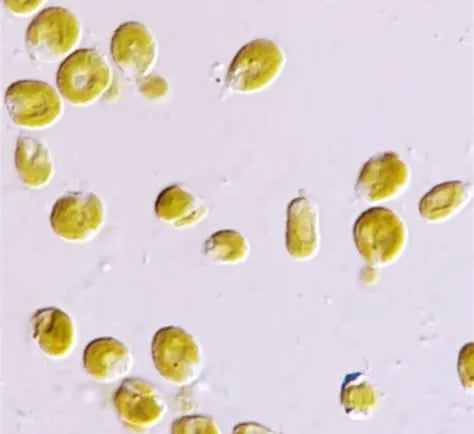
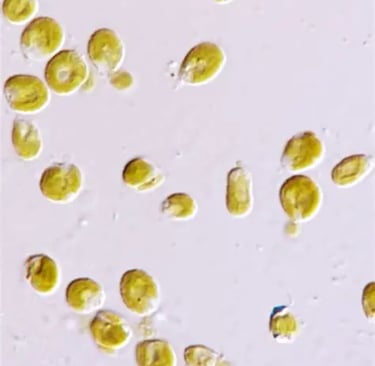
Tisochrysis and Isochrysis are very similar algae that share the same family but branch off at the species and genus level. "In contrast, the T-ISO clone of Isochrysis has only 50 to 70% of the DHA of Isochrysis galbana when grown in side-by-side culture in the same conditions of light and nutrients". This quote shows that Isochrysis actually has a higher DHA content compared to Tisochrysis, making it nutritionally superior. However, Tisochrysis has a thinner cell wall and is more tolerant of higher temperatures than Isochrysis, making it a preferred species over it's cousin.
Tisochrysis has also adapted to the Polynesian islands in Taihiti, most likely explaining it's tolerance for higher temperatures. At Orr Biologicals, we culture Isochrysis galbana because we want algae with the highest DHA possible.
Isochysis galbana is renowned in aquaculture for it's extremely high DHA content (Docosahexaenoic acid) and is only rivaled in terms of nutrition with Pavlova Lutherii. It is a small microalga that ranges from 4-6 microns in size, making it a suitable microalgae for Nauplii stages of copepods and bivalve larvae in the D hinge stage.
This marine haptophyte can be stressed under certain conditions to increase lipid content. Two examples of this are cold and nitrogen deprivation stress. When Isochrysis is exposed to these factors, it starts to store energy in the form of lipids (golden fats) that can be used to survive what it thinks are stressors. We as scientists can harness this trait by shocking the phytoplankton, not enough to kill it, increasing lipid levels.
“Part 5 Hatchery Operation: Culture of Larvae Basic Methodology, Feeding and Nutrition, Factors Influencing Growth and Survival, and Settlement and Metamorphosis.” The Hatchery Culture of Bivalves: A Practical Manual, www.fao.org/4/y5720e/y5720e0a.htm#bm10.2.1. Accessed 04 Apr. 2026.
© 2026 Orr Biologicals. All rights reserved.
Phyconet is an experimental open‑source project. Results will vary depending on your algae strain, reactor setup, and local conditions. We make no guarantees of specific yields. The AI is a research tool, not a certified safety device. By supporting this campaign, you’re helping us test and improve a prototype that we believe will make algae cultivation easier for everyone.
Limitation of Liability
To the fullest extent permitted by law, Orr Biologicals and its owners shall not be liable for any direct, indirect, incidental, or consequential damages arising from your use of the spirulina cultures, the information on this site, or any products derived from them. This includes, but is not limited to, illness, allergic reactions, or economic losses.
Compliance with Local Laws
Spirulina cultivation and sale may be regulated in your area. It is your responsibility to check with your local health or agricultural authority before buying or growing spirulina. We do not certify that our cultures meet any particular legal standard for food safety.
Please note that the creator of MAIN is a minor operating this project
as an educational and non‑commercial open‑source initiative.
Any purchases, donations, or transactions are processed through
third‑party platforms (e.g., Experiment.com, BTCPay Server) and are
subject to those platforms' terms and age requirements. By supporting
this project, you acknowledge that you are engaging with an open‑source
community effort, not a legally incorporated business.