
Grow phytoplankton at home
Grow phytoplankton at home
GUIDES
12/1/20254 min read
Disclaimer: Before embarking on your journey, please read the terms and conditions.
Briefing
In order to grow phytoplankton, just some scientific background. Phytoplankton, such as Nannochloropsis oculata, are microscopic algae that thrive in temperate to warm marine waters. They require specific sea salts, nutrients, and conditions to photosynthesize, just like plants. More specifically, temperature should be 70–80 degrees Fahrenheit for optimal growth. Furthermore, the Salinity for optimal growth should be 25–35 ppt (parts per thousand). Another factor would be to use a light meter on a phone that measures LUX in order to determine whether the algae cells are getting enough light. The lux should measure between 2,000–5,000. Also should be nutrients. Here is a list of equipment. There are many species of phytoplankton; Nannochloropsis is a small, non-motile green ball, while Tetraselmis is larger and mobile. We prioritize Nannochloropsis for its high EPA content.
List of Materials
1. Containers/Growing Vessel
For a growing vessel, it should be cylindrical and transparent to allow light to penetrate the algae culture for the cells to photosynthesize. Also, it needs to be salt-safe, so a glass vessel should be fine. You can use borosilicate glass or polycarbonate, as it does not leech chemicals and is durable. It should have a cap or covering of some sort. A five-gallon glass jar is best for transparency and safety. For home cultivation, you can expect a dense green "pea soup" consistency. It can take 7–10 days for home cultivation systems to reach peak density, but this varies up to 3 weeks for larger containers. Go for 10–20 liter containers for bulk production. It can take longer if you start with a small inoculation and want to scale to larger amounts. Experiment with this, Phytoplankton grows faster or slower depending on the environment you provide it! Do be careful to make sure to put the vessel away from wires or places where spills are dangerous.
For larger operations, go for food-safe plastic carboys or even photobioreactors for businesses. Search for "5 gallon plastic/glass water jug dispenser transparent" or "5 gallon glass/plastic water jug" depending if you want a spigot or not. Or, you can use a pump which we will discuss later. Glass water jug ~$50 or cheaper | Plastic drink dispenser ~$15 but less durable.
2. Lighting
Phytoplankton are evolutionary considered as plants, and as such, they also are photosynthetic meaning they require sunlight for growth. In order to ensure the phytoplankton is getting adequate light, use an app on your phone and download a light meter app like LUX meter to measure light illuminance. Open the app and point the camera through the culture and see what the LUX value is. It should be between 2,000–5,000 LUX, according to many studies. As for the light source, you can place the culture on a sunny window ledge or even outside. Or, you can use LED lights that have the entire spectrum with spikes in red and blue.
If you are a more advanced grower, use a PAR meter. Aim for 50–200 µmol m⁻² s⁻¹ reading within the PAR for most marine species. Basically, phytoplankton absorbs wavelengths in the 430 and 680 nm, so a PAR meter will help you find out how much light they are getting.
3. Heating
Phytoplankton is generally more temperate than spirulina. To provide fast growing rates, a submersible aquarium heater is sometimes needed if your room is cold. I find phytoplankton grows alright without a heater at room temperature, but this results in a slower growth rate. To accelerate growth, aim for 75–78 degrees Fahrenheit (24–26 C) which can be done with an aquarium heater. Make sure the temperature does not fall below 60 degrees Fahrenheit (15.5 C) or rise above 85 degrees Fahrenheit (29 C) for most green marine species.
4. Culture Media and Harvesting
Like any other algae, phytoplankton needs nutrients and a special set of salts to grow. More specifically, the Guillard’s F/2 medium is the gold standard. For these ones, just follow the directions and add to filtered, sterilized saltwater (approx. 1.025 specific gravity). Feed the culture all at once with the media.
To cultivate phytoplankton, ensuring sterility is the most important factor. Use 0.22-micron inline air filters to prevent contamination.
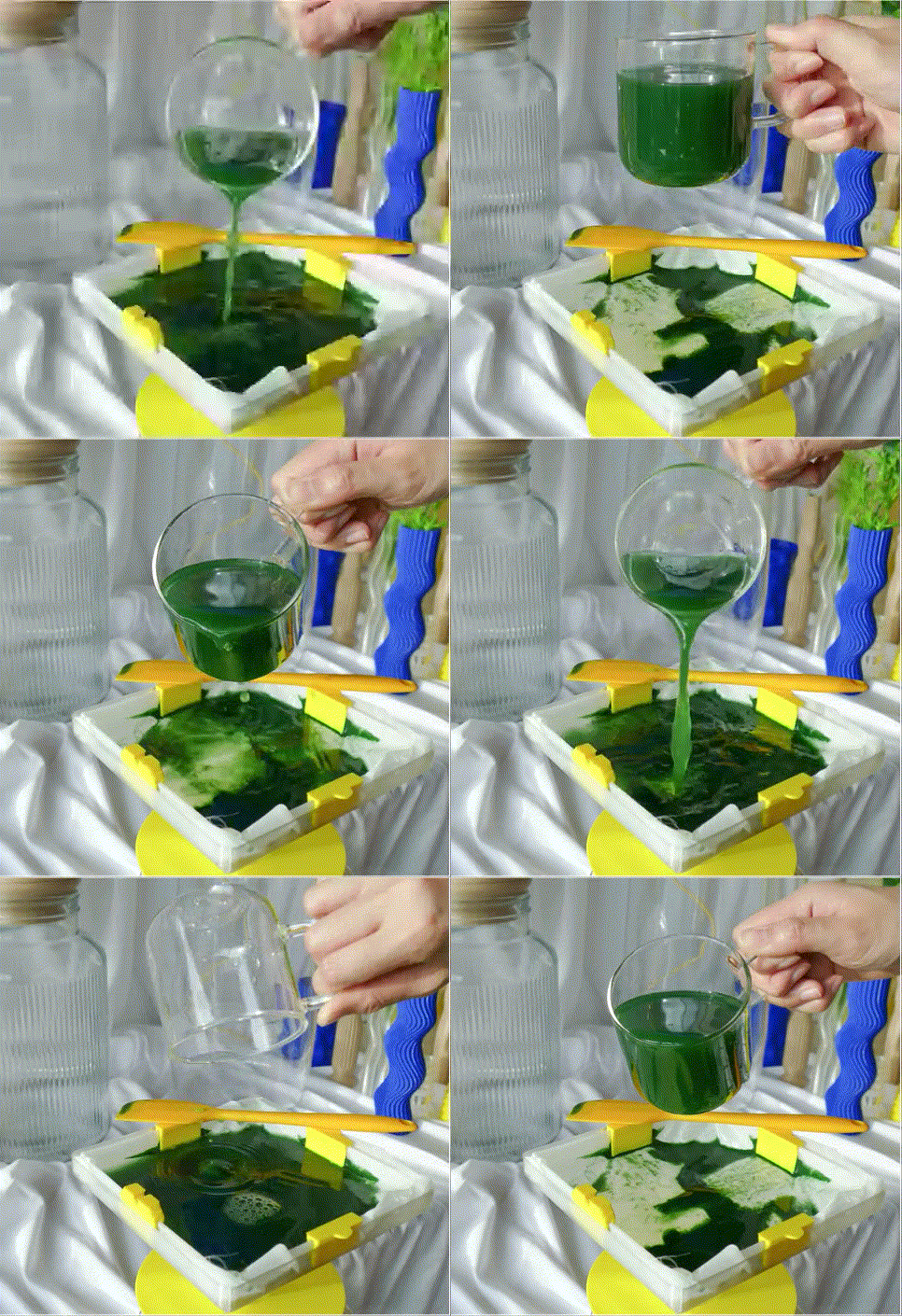
After it is ready to harvest, what you want to do is siphon or use a dispenser for how much phytoplankton you want. Unlike spirulina, phytoplankton is too small for a fine mesh; you harvest the liquid itself. You can use this liquid to feed copepods, bivalves, or reef tanks directly. There are three ways to cultivate: Batch, Semi-continuous, and Continuous. Batch: add nutrients for 5 gallons, wait for peak green color, harvest all. Semi-continuous: harvesting 20–30% of the volume and replacing it with fresh sterile saltwater and nutrients. Continuous: using a drip system to harvest and replace volume constantly. Contamination is a high risk factor here.
To measure when the culture is ready, use a Secchi stick. When the white disk disappears at a shallow depth (1–3 cm), the culture is dense and ready.
5. Aeration
For optimal growth, phytoplankton require adequate access to carbon dioxide and constant suspension. Unlike spirulina, bubbles are required to keep the cells from settling at the bottom and dying. Use a rigid airline reaching the bottom of the vessel. Try not using air stones, as they are impossible to clean and can harbor bacteria that impede the health of the culture.
6. Obtaining a Culture
To grow phytoplankton, you need a living starter culture. When you receive it, immediately open the lid and check the color. It should be a vibrant green with no "rotten" smell. Transfer to new sterile media and light immediately.
7. Usage (Consuming/Feeding)
Phytoplankton is primarily grown to feed aquatic life. Here is a checklist before use:
Rinse equipment before and after use.
Do not use if the culture has "crashed" (turned clear or brownish).
DO NOT USE IF THE CULTURE SMELLS LIKE SULPHUR OR ROTTEN EGGS.
Store harvested phytoplankton in the refrigerator for up to 2-4 weeks; shake daily to keep cells in suspension.
Verify with a microscope; you should see moving cells (if Tetraselmis) or small green spheres (if Nannochloropsis).
Excerpts from Cultivation Guides: → Yellow-green/lime green = too much light or nutrient deficiency → Dark forest green = healthy/dense → Brown/Clear = dead/crashed → Smell = Should smell like fresh grass or the ocean; any foul odor indicates bacterial contamination.

© 2026 Orr Biologicals. All rights reserved.
Phyconet is an experimental open‑source project. Results will vary depending on your algae strain, reactor setup, and local conditions. We make no guarantees of specific yields. The AI is a research tool, not a certified safety device. By supporting this campaign, you’re helping us test and improve a prototype that we believe will make algae cultivation easier for everyone.
Limitation of Liability
To the fullest extent permitted by law, Orr Biologicals and its owners shall not be liable for any direct, indirect, incidental, or consequential damages arising from your use of the spirulina cultures, the information on this site, or any products derived from them. This includes, but is not limited to, illness, allergic reactions, or economic losses.
Compliance with Local Laws
Spirulina cultivation and sale may be regulated in your area. It is your responsibility to check with your local health or agricultural authority before buying or growing spirulina. We do not certify that our cultures meet any particular legal standard for food safety.
Please note that the creator of MAIN is a minor operating this project
as an educational and non‑commercial open‑source initiative.
Any purchases, donations, or transactions are processed through
third‑party platforms (e.g., Experiment.com, BTCPay Server) and are
subject to those platforms' terms and age requirements. By supporting
this project, you acknowledge that you are engaging with an open‑source
community effort, not a legally incorporated business.