Species guide
Phaeodactylum
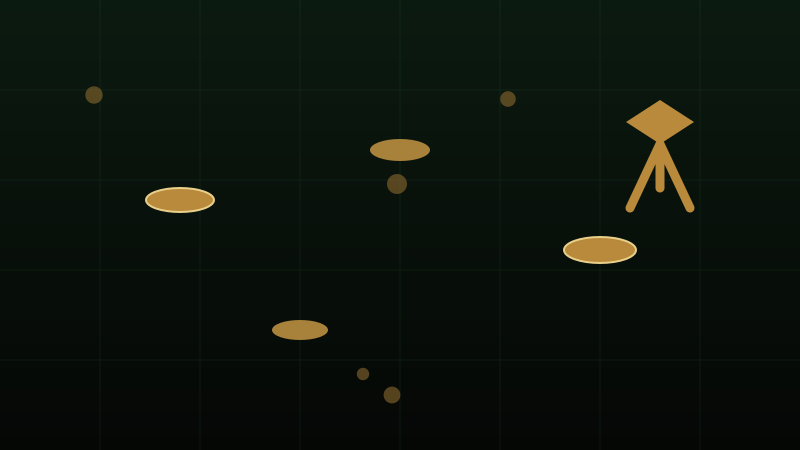
Phaeodactylum tricornutum is the diatom science knows best: a golden-brown, boat-shaped cell that grows happily in flasks, yields EPA and fucoxanthin, and serves as the genetic workbench for the entire diatom lineage.
- What it is
- A marine diatom and one of the most-studied microalgae in biology — a model organism with a published genome.
- Taxonomic group
- Bacillariophyceae (diatoms); Phaeodactylum tricornutum is the single species of its genus.
- Typical appearance
- Golden-brown cells in several forms — fusiform (boat-shaped), triradiate (three-armed) and oval. Fusiform dominates in culture.
- Typical size
- Fusiform cells roughly 10–25 µm long.
- Culture characteristics
- Fast-growing and reliable in standard marine media; needs silicate like all diatoms. Tolerant for a diatom.
- Major applications
- EPA production research, fucoxanthin source, model organism for diatom genetics, live feeds in some hatchery programs.
- Typical users
- Research laboratories, biotech companies, some aquaculture live-feed rooms.
Why aquaculture values it
Phaeodactylum bridges the lab and the hatchery. In feed programs it plays the diatom role — sterols, pigments, EPA — where a reliable non-chain-forming species is preferred. In research it is the diatom whose genome and genetic tools are best characterised, which is why 'engineered diatom' almost always means this species.
Nutrition and important compounds
EPA is its marquee lipid, and fucoxanthin — the brown pigment that gives diatoms their colour — is an active research topic for metabolic applications. Silicate is a non-negotiable nutrient: no silica, no diatom.
A note on culture parameters
Its three morphotypes appear under different conditions and strains. Compare published numbers only within the same morphotype and strain.
Frequently asked questions
Why is Phaeodactylum called a model organism?
It was an early diatom with a published genome and has the best genetic tools of any diatom. Much of what is known about diatom metabolism comes from studying it.
Why does it have three shapes?
It is pleomorphic — fusiform, triradiate and oval forms appear depending on conditions and strain. The fusiform form is what most cultures maintain.
Do I need to add silica?
For any diatom, yes: silicate is a structural nutrient for the cell wall. Standard marine media such as f/2 include it.