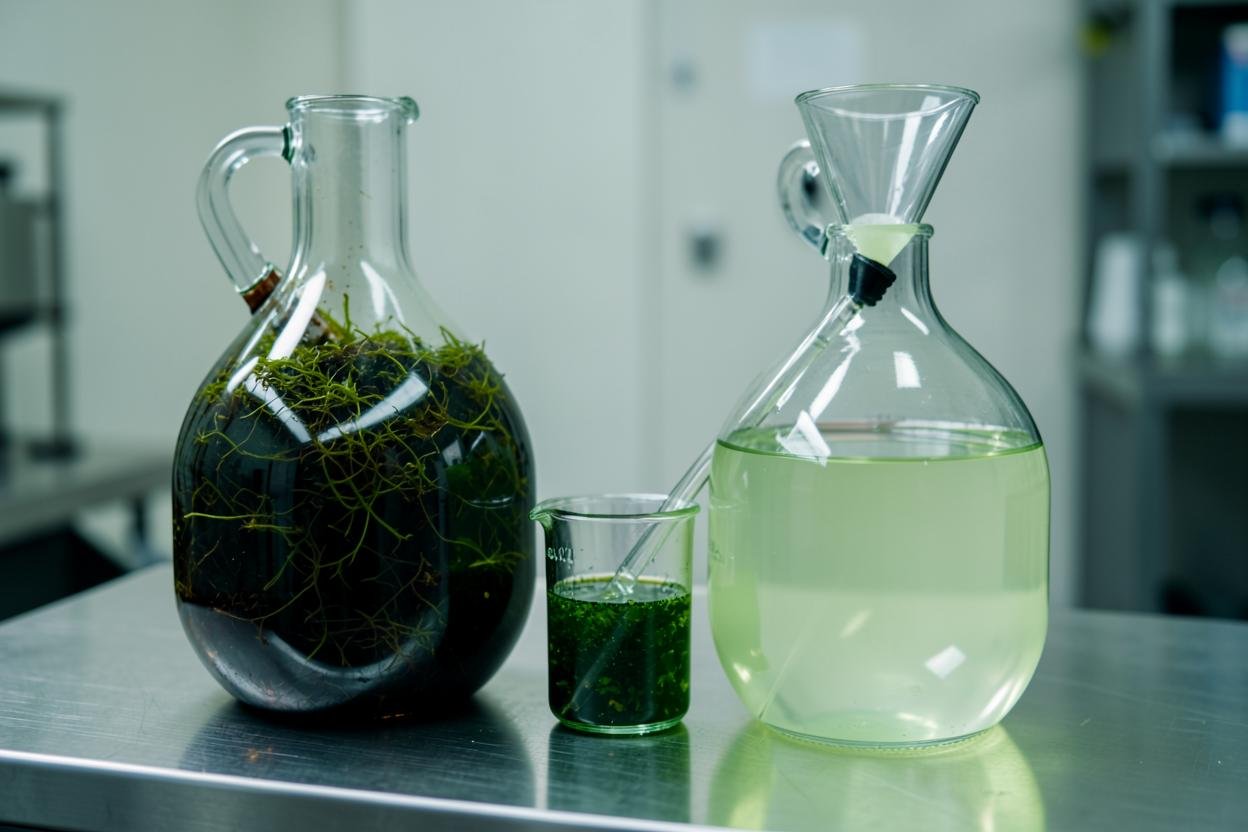
Why split at all
A batch culture is a race between how fast the cells divide and how fast they use up the food in the water. When the nitrogen runs out first, the cells stop dividing and start thickening their walls. They are still alive, and they are still green, but they are no longer a starter — they are a stalled population that will take a week to recover, if it recovers.
Splitting resets the race. You take the dense culture, give it twice the water and the food for that water, and the cells go back into rapid division within a day. Do it weekly and the line never ends. Skip it and the culture overshoots, crashes, and takes the week's feeding with it.
When to split
Three signs, in order of reliability:
- The Secchi reading stops changing. You take the reading twice a week; when the depth stops getting shallower, the culture has caught up with its food.
- The colour is as dark as it gets. Deep, even green with no pale edge. For a golden-brown strain, a rich amber-brown.
- The date. Five to seven days from the last split, at room temperature with 12 to 16 hours of light. If you cannot remember when it was last split, split it now.
Do not wait for yellow. Yellow-green at the surface means the nitrogen has already run out and the cells are stressed; a split will rescue it, but it will take longer than a split done a day earlier. And do not split a culture that smells wrong or has a brown film — you would be giving a contaminant twice the volume.
The amounts for a one-to-one split
| Culture before | Into the clean vessel | Fresh saltwater added to each | Salt | f/2 to each | After |
|---|---|---|---|---|---|
| 1 L | 500 mL | 500 mL | 15 g | 1 mL | 2 × 1 L |
| 2 L | 1 L | 1 L | 30 g | 2 mL | 2 × 2 L |
| 3.2 L — the kit batch | 1.6 L | 1.6 L | 48 g | 3.2 mL | 2 × 3.2 L |
The salt and f/2 are for the fresh water you add, not for the whole vessel. Salt at 30 g per litre, f/2 at 2 mL per litre. Both vessels finish at the same volume, so the two halves are the same strength and can be treated identically from here.
The split, step by step
- Clean the second vessel like you mean it. Hot water and a brush, no soap, then a rinse with the same distilled water you are about to use. A dirty vessel is the most common way a healthy culture picks up a ciliate.
- Mix the fresh saltwater first. Salt into distilled or RO water, stirred until clear. If you add salt after the culture, you are salting live cells directly.
- Pour half across. No need to be exact. Half is half. A funnel helps, and so does pouring down the side rather than from a height.
- Top both up and dose. Fill each vessel to its working volume with the fresh saltwater, leaving a hand's width of headspace at the neck. Add the f/2 to each and swirl gently.
- Put the air back. One airline per vessel, or split the pump with a T-piece and a valve so both get a gentle stream. Both vessels need movement, not just the new one.
- Label both. Strain, date, and which half is the older culture. Then write the same date on the mini card that came with the bottle. Two vessels with no dates are two vessels you will guess about later.
From here, use the older half first and let the newer one grow. Next week, split whichever is densest, and keep rotating. The point is not to have two identical cultures; it is to have one ready to feed and one growing behind it.
Scaling past a gallon
The same arithmetic works at any size, which is why it is worth writing the numbers down once. A 20-litre bucket is a 20-litre batch: 600 g of salt, 40 mL of f/2, and a starter volume that is about a tenth of the total. The parts that change are the ones a home bench does not have: a bigger air supply, a light that covers the whole surface, and a way to clean a vessel that no longer fits in the sink.
Two practical cautions. First, a wide shallow vessel catches more light per litre than a tall narrow one, so a bucket will usually outgrow a carboy of the same volume. Second, more volume means a mistake is more expensive — split small batches until the routine is boring, then scale.
Four ways a split goes wrong
- Splitting a sick culture. If it smells wrong, has a film, or has been pale for days, fix or discard it. Dividing a problem only makes two problems.
- Chlorinated water. The single most common cause of a split that never greens up. Distilled or RO only.
- No headspace. A brim-full vessel cannot exchange gas. Fill to the shoulder, not the neck.
- Using the last of it. If you feed out the entire batch, the next crash has nothing to restart from. Keep one vessel you do not touch until the other is clearly growing.
The hatcheries that never lose a spawn to algae are not the ones with the biggest cultures. They are the ones with a second bottle in the fridge before the first one is needed.
Start the line with a bottle
A 16 oz culture, 50 mL of f/2 and a mini strain card for $15. Add 1,000 g of marine salt for $5 and you have the water for the first two splits. If you are feeding larvae rather than growing a culture, start with a blend instead.