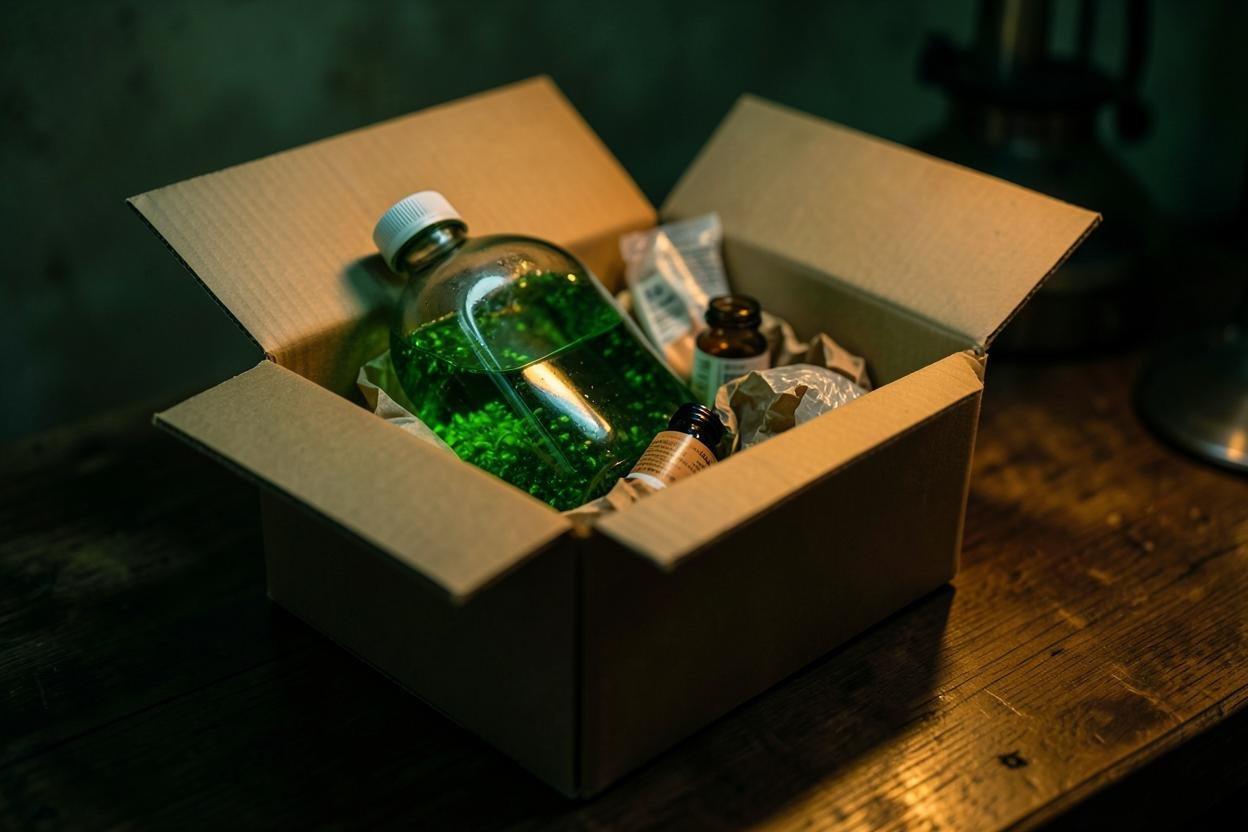
A live starter is not a bottle of feed. It is a population of cells that was dividing when it was packed and has been sitting in the dark since. The cells are tougher than they look and can handle a two-day journey, but they cannot handle being opened over a warm sink and poured into cold water. The routine below is short on purpose: it removes the four things that kill a delivery, and nothing else.
What should be in the box
- The bottle. 16 oz — 473 mL — of actively dividing culture, sealed, labelled with the strain, the count and the pack date.
- 50 mL of f/2. The food. It is included with every bottle and it treats about 25 litres, which is a gallon batch plus a couple of splits.
- A mini strain card. One per algae in the order. It is the size of a business card and it carries the numbers you will be squinting at in a month.
- The cold pack. In warm months. It is there to stop the box overheating in a depot, not to refrigerate the culture.
If a bottle is missing or leaking, photograph the box before you move anything. It is much easier to replace an order when the packing is still in the picture.
Open it out of the sun
Take the box somewhere shaded and room-temperature. A bench, a counter away from the window, or the floor of a cool room. Direct sun through a window will heat a sealed bottle past 30 °C in minutes, and above roughly 35 °C a culture dies fast — gel pack or no gel pack.
Keep the bottle upright while you unpack. A culture that has been on its side is not ruined, but the cells settle into a dense band and take a day to redistribute. Upright means less work for the first split.
Check three things before you open it
- The seal. The cap should be tight and the bottle should not be wet. A leak means oxygen and contaminants got in and culture got out.
- The colour. Deep green for Nannochloropsis and Tetraselmis; golden-brown for T-Iso; olive-brown for the diatoms. A culture that is clear, milky or has a hard white ring at the waterline is not healthy. A little sediment at the bottom is normal — cells settle in transit.
- The smell. Open the cap for a second. It should smell like the sea or like fresh greens. Rotten eggs, sour milk or a swamp means something else grew in it.
Do not taste it and do not put it near your mouth. These cultures are sold for aquaculture, research and education, not for people.
Let it settle before you pour
Leave the sealed bottle on the bench for 30 to 60 minutes. This is not superstition. A bottle that has been in a cold depot and then a warm van is at a different temperature from your water, and a sudden jump shocks cells that are already stressed from the journey. Room temperature first, then the batch.
While it settles, mix the water it is going into. Salt at 30 parts per thousand — about 30 g per litre — dissolved until clear, then f/2 at 2 mL per litre. If you are using the one-gallon kit, the day-by-day kit setup has the exact amounts.
Then either start it or hold it
If you have the saltwater ready, pour the bottle in. All of it, at the ratio in the starter guide. A bottle kept back "for later" ages on a shelf while the batch it was meant to seed runs at half density.
If you are not ready, the sealed bottle can hold for a few days in a cool, shaded spot — not a fridge, which is too cold, and not a windowsill. Treat it as borrowed time. The pack date on the label is the day the culture was at its best, and every day after that is a little slower to start.
Photograph it, once
Take one picture of the bottle and its label in daylight, and keep it with your notes. Two reasons: it is the batch record you will want when you compare growth between orders, and it is what we ask for if something goes wrong. If a culture arrives dead, a photograph within 24 hours is all it takes to have it replaced — that is the whole warranty, and it is the only one that matters with live material.
Put the card where you will use it
The mini card is not packaging. Every order ships with one card for each algae, and it is meant to live on the shelf next to the vessel. One side has the strain and what it feeds; the other has the numbers that decide whether the batch works — cell size, salinity, light hours and the split ratio. When the bottle is gone and the label with it, the card is still there.
If you keep more than one strain, the cards are also how you stop mixing them up. Six bottles look alike at a glance at seven in the morning. Six cards on the shelf do not.
A bottle, its food and its card — $15
Every 16 oz culture ships with 50 mL of f/2 and a mini strain card. Add 1,000 g of marine salt for $5 and the box is $20. Order from the store, or read how to feed a blend if you are buying for larvae rather than starting a culture.
Cultures are shipped Monday to Wednesday, US only, so they do not sit in a depot over a weekend. In warm months the box goes out insulated with a cold pack.