Species guide
Dunaliella
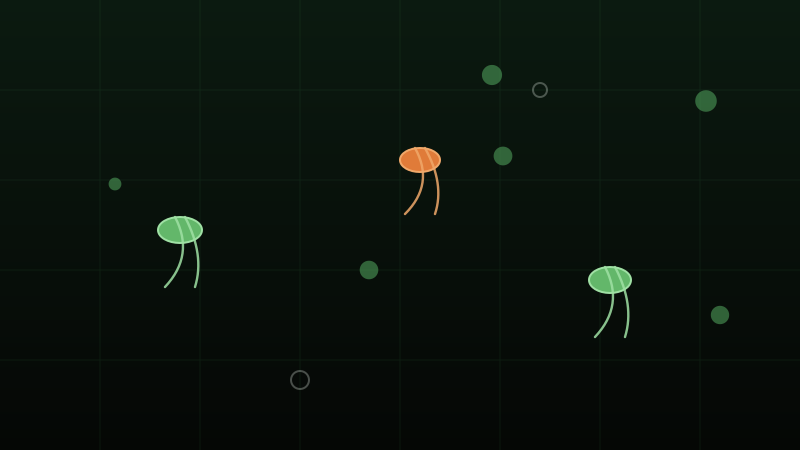
Dunaliella is the extremophile of the useful algae: a wall-free green flagellate that survives salt concentrations that would pickle everything else, and turns sunshine and stress into the world's supply of natural beta-carotene.
- What it is
- A genus of motile green microalgae famous for tolerating extreme salt — D. salina turns carotenoid-orange under stress.
- Taxonomic group
- Chlorophyta (green algae), family Dunaliellaceae.
- Typical appearance
- Ovoid green (or orange-red when stressed) cells with two long flagella; no rigid cell wall — it balances osmotic pressure by accumulating glycerol instead.
- Typical size
- Cells roughly 5–15 µm depending on species.
- Culture characteristics
- Extreme halophiles like D. salina grow in hypersaline ponds where predators and competitors mostly cannot follow. Other species prefer normal marine or freshwater salinities.
- Major applications
- Natural beta-carotene production (the dominant commercial source), glycerol research, salinity-stress studies, some live-feed uses at lower salinities.
- Typical users
- Beta-carotene producers operating salterns, biotech researchers, specialised aquaculture operations.
Why aquaculture values it
Dunaliella's aquaculture footprint is narrower than the feed workhorses', but its biotechnology story is the biggest in the field: it is the commercial source of natural beta-carotene, grown in enormous hypersaline ponds. In live feeds it appears in specialized applications, and its osmotic tricks make it a model organism for salt-stress research.
Nutrition and important compounds
Under stress — high light, nutrient limitation, high salinity — D. salina accumulates large amounts of beta-carotene as a photoprotective measure, plus glycerol as an osmotic balancer. Both are the reason the species is industrially famous.
A note on culture parameters
Culture parameters differ radically between species: D. salina lives at salt concentrations few organisms tolerate, while other Dunaliella species prefer ordinary conditions. Never transfer a parameter between them.
Frequently asked questions
Why does Dunaliella turn orange?
Stress — high light, high salt, nutrient limitation — triggers beta-carotene accumulation as a photoprotective measure. The orange cells are the product.
Can I culture Dunaliella at home?
D. salina needs hypersaline water — inconvenient but protective, since few contaminants follow it. Other species grow at normal salinity but bring normal contamination risks.
Is algal beta-carotene different from synthetic?
It is a natural mixed-isomer form extracted from algae and commands a premium in food and supplement markets. The market distinguishes the source, not the molecule alone.