Applications · Aquaculture
Phytoplankton for bivalves.
Oyster, clam, scallop and mussel larvae will not eat flake, pellet or powder — they filter live microalgae, and hatchery success rises or falls on feeding them the right cells at the right size. This is the aquaculture bench, written down.
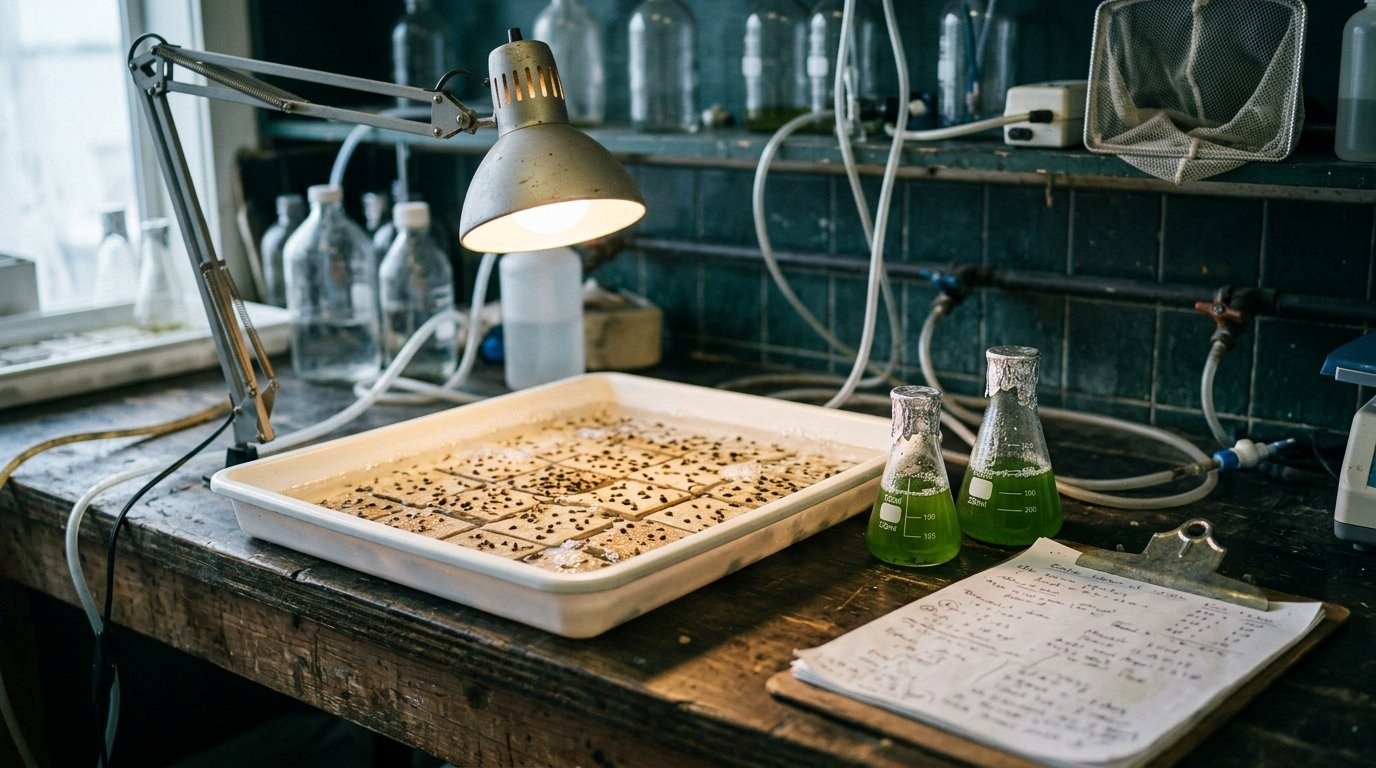
Why live feed
Bivalve larvae are non-selective filter feeders: they capture suspended cells between roughly 1 and 10 micrometres, and survival through larval stages tracks ration, cell size and nutritional quality. D-larvae through to pediveligers consume mixed live diets in virtually all commercial hatcheries — dried algae and yeast-based feeds have not displaced live phytoplankton at larval stages. That is an empirical fact of the industry, not a marketing position.
A workable mixed diet
Hatcheries rarely rely on one species. A common pairing is one golden/chrysophyte strain (Tisochrysis lutea “T-ISO” or Isochrysis galbana) plus a flagellate or diatom — Pavlova lutheri or small Chaetoceros spp. — because nutritional profiles complement each other and size ranges bracket larval prey capture. Details: species and stage matching.
The four skills that matter
- Species selection — matching cell size and nutrition to larval stage
- The feeding protocol — concentration, frequency and siphoning
- Water quality — salinity, temperature, filtration and why copper kills tanks
- Troubleshooting — crashes, mortality, settlement failure
Home-scale, honestly
Hobbyists can maintain a few algal cultures (T-ISO and Pavlova are forgiving) and grow a small batch of juvenile oysters or clams from purchased seed — often a few dozen animals. Expect 30–60 days from fertilisation to spat for warmwater oysters, high natural mortality, and strict water discipline. Yields are educational more than economic. Do not release farmed stock into open waters, and do not move broodstock across regions — biosecurity and hatchery regulations (including disease and genetic rules) apply; your local fisheries authority is the binding source, not this page.
What this is not
Not a business plan, not a certification, not legal advice and not a substitute for a working hatchery. Production data below are order-of-magnitude literature values, not Orr Biologicals measurements.
Sources
- Helm MM, Bourne N, Lovatelli A. Hatchery culture of bivalves — A practical manual. FAO Fisheries Technical Paper No. 471, Rome, 2004. FAO.
- Brown MR. “Nutritional value of microalgae for aquaculture.” Chapter in algal-culture literature; use FAO 471 as the operational reference.
- FAO Fisheries Technical Papers on hatchery management — see FAO Legal Office and your national fisheries authority for binding rules.
Connect this guide to the wider research
This protocol connects to algae biotechnology fundamentals, cultivation conditions and monitoring, and how we separate observations from guesses. Protocols are educational starting points — not validated production protocols.
Methodology and evidence status · Scientific definitions · Safety and scope.