Applications · Cultivation
Spirulina, kept simply.
Spirulina is a warm, alkaline water culture — a cyanobacterium, not a pond weed — that rewards patience, light and a notebook more than equipment.
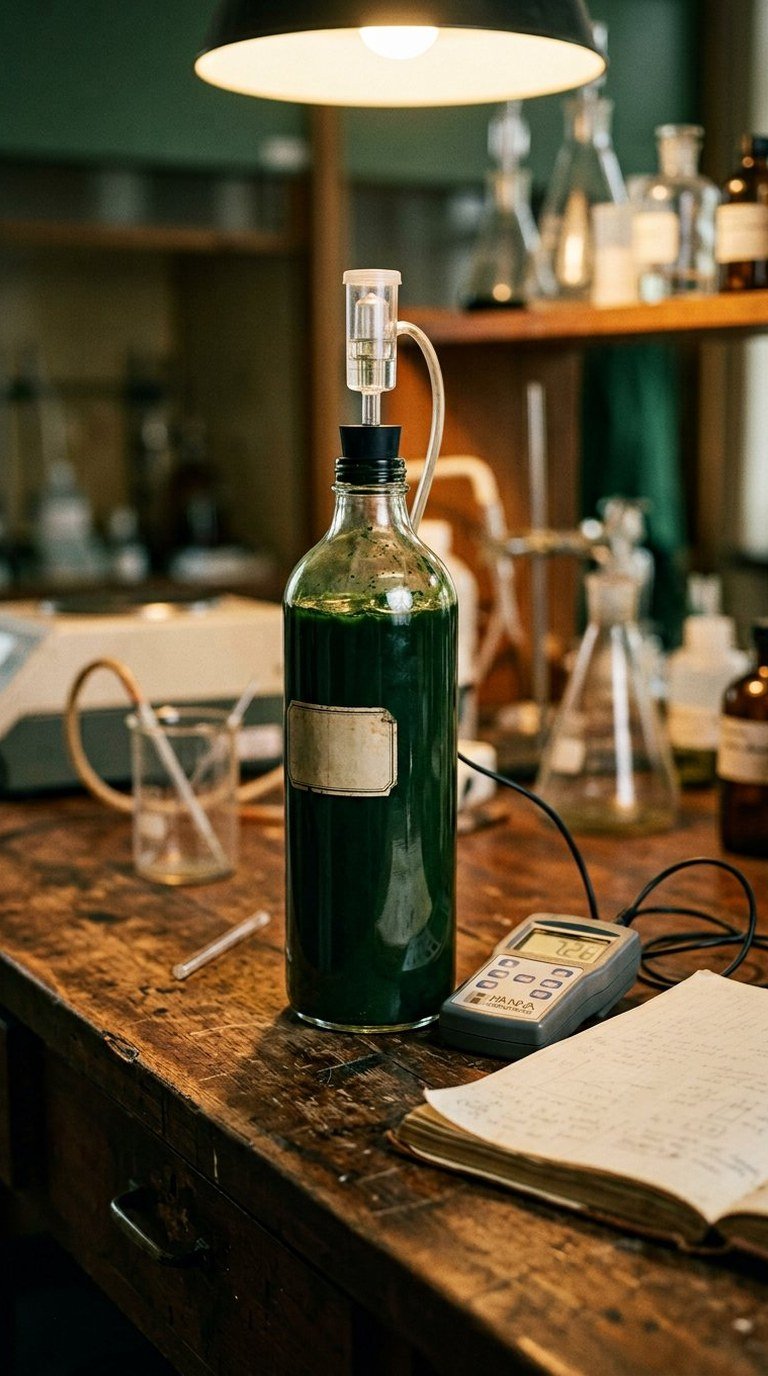
Know the organism first
Arthrospira platensis (marketed as “spirulina”) is a filamentous cyanobacterium that evolved in alkaline lakes. It is not the same organism as the spirally coiled Spirulina sensu stricto, and it is definitely not the green growth on any random pond — a green bottle is suggestive, never conclusive. Keep your inoculum from a documented culture, not from the wild.
What the culture wants
| Requirement | Typical working range | Watch for |
|---|---|---|
| pH | Roughly 9–10.5, bicarbonate-buffered | Drifting downward means carbonate/bicarbonate depleted — feed with sodium bicarbonate |
| Temperature | Roughly 25–35 °C | Growth stalls under ~20 °C; sustained heat over ~38 °C kills it |
| Light | Bright but not harsh direct midday sun | Pale or olive culture = too little light or too much self-shading |
| Mixing | Gentle, daily swirling or aeration | Settling at the bottom = feed the surface light and re-mix |
| Medium | Zarrouk-type bicarbonate medium | See our medium notes |
The short version
- Your first culture, weeks 1–4 — a documented inoculum and a feeding rhythm
- Reading the culture — colour, foam and sediment as field signs
What spirulina is not
It is not a protein shake you grow in a jam jar, not proof of safety by appearance, and not a licensed drug or supplement. Home cultures are a citizen-science exercise with a harvestable by-product; identity, purity and safety need laboratory verification. Treat homegrown biomass as an experiment, never as a tested supplement — especially if immunocompromised.
Sources
- Vonshak A (ed.). Spirulina Platensis Arthrospira: Physiology, Cell-biology and Biotechnology. Taylor & Francis, 1997 — the standard reference on the organism.
- Schagerl M, et al. “Estimating biomass and vitality of microalgae.” J Plant Biotechnol, 2022. PMC9368473 — measurement proxies and their limits.
- Benner SM, et al. “Lab-scale photobioreactor systems: principles, applications, and scalability.” 2022. PMC9033726.
Connect this guide to the wider research
This bench protocol connects to the guide shelf, cultivation conditions and monitoring and how we separate observations from guesses. Protocols are educational starting points — not validated production protocols.
Methodology and evidence status · Scientific definitions · Safety and scope.